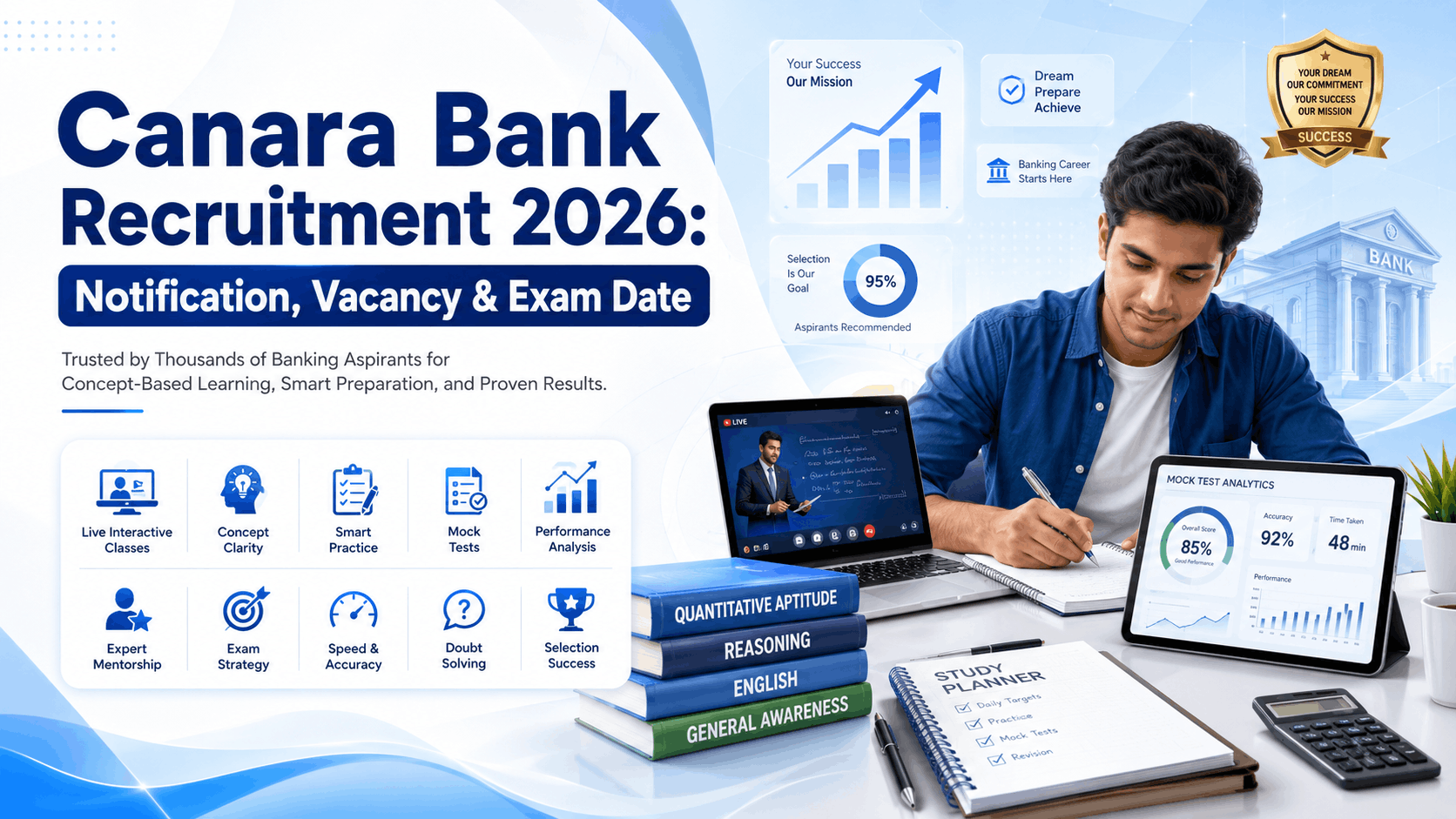
IBPS Clerk Preparation Tips 2026: Section-Wise Strategy, Exam Pattern & Study Plan

30th July 2026
Preparing for the Institute of Banking Personnel Selection (IBPS) Clerk Examination requires a structured study plan, continuous practice, and an in-depth understanding of the exam pattern. Candidates who have completed graduation degree courses in any discipline (such as B.A., B.Sc., B.Com., B.Tech, B.E., or equivalent) from a recognized university can participate in this national-level recruitment drive for Customer Service Associate (Clerk) positions across participating public sector banks. A well-organized, section-wise strategy ensures candidates master key quantitative, reasoning, and language skills necessary to qualify both the Preliminary and Main examinations on their first attempt.
IBPS Clerk Preparation 2026 – Overview
| Particulars | Details |
| Exam Conducting Body | Institute of Banking Personnel Selection (IBPS) |
| Post Name | Customer Service Associate / Clerk (CRP CLERK-XVI) |
| Selection Process | Phase I: Preliminary Exam
Phase II: Main Exam |
| Mode of Exam | Online Computer-Based Test (CBT) |
| Negative Marking | 0.25 Marks deducted for every incorrect response |
| Official Website | ibps.in |
Important Dates
| Event | Date (Tentative / Cycle Schedule) |
| Official Notification Release | July 2026 |
| Online Application Window | July – August 2026 |
| IBPS Clerk Preliminary Examination | August / September 2026 |
| Preliminary Exam Result | September 2026 |
| IBPS Clerk Main Examination | October 2026 |
| Provisional Allotment Rollout | April 2027 |
Eligibility Criteria & Vacancy Overview
Educational Qualification & Competency
- Degree Qualification: Graduation degree course in any discipline (B.A., B.Sc., B.Com., B.Tech, B.E., or equivalent) from a recognized University or Institute approved by the Government of India.
- Computer Literacy: Operating and working knowledge in computer systems (Certificate, Diploma, or Degree course in computer operations or studied computer science in high school or college) is mandatory.
- Local Language Proficiency: Candidates must read, write, speak, and understand the official regional language of the state or UT for which they apply.
Age Limit (As on Official Cut-Off Date)
| Category | Minimum Age | Maximum Age | Upper Age Relaxation |
| General / EWS | 20 Years | 28 Years | Nil |
| OBC (Non-Creamy Layer) | 20 Years | 28 Years | 3 Years |
| SC / ST Candidates | 20 Years | 28 Years | 5 Years |
| PwBD Candidates | 20 Years | 28 Years | 10 Years |
Selection Process & Exam Pattern
The recruitment drive comprises two competitive online examination phases: Phase I Preliminary Examination and Phase II Main Examination. There is no interview round for clerical cadre posts in public sector banks.
Phase I: Preliminary Examination Pattern
The Preliminary exam serves as a qualifying screening test consisting of 100 objective questions carrying 100 marks, with 20 minutes allocated to each section.
| Section / Subject | Number of Questions | Maximum Marks | Sectional Timing |
| English Language | 30 | 30 | 20 Minutes |
| Numerical Ability | 35 | 35 | 20 Minutes |
| Reasoning Ability | 35 | 35 | 20 Minutes |
| Total | 100 | 100 | 60 Minutes |
Phase II: Main Examination Pattern
Candidates qualifying the Prelims cutoff appear for the Main Examination. Final selection and merit ranking are calculated strictly on the basis of marks scored in the Main Examination.
| Section / Subject | Number of Questions | Maximum Marks | Sectional Timing |
| General / Financial Awareness | 50 | 50 | 35 Minutes |
| General English | 40 | 40 | 35 Minutes |
| Reasoning Ability & Computer Aptitude | 50 | 60 | 45 Minutes |
| Quantitative Aptitude | 50 | 50 | 45 Minutes |
| Total | 190 | 200 | 160 Minutes |
Section-Wise IBPS Clerk Preparation Strategy
| Subject / Section | High-Weightage Topics | Proven Preparation Tips |
| Reasoning Ability | Puzzles, Seating Arrangement, Syllogism, Blood Relations, Coding-Decoding, Inequality | • Solve 4–5 puzzle and seating arrangement sets daily.
• Master syllogisms and inequalities first to build speed. • Practice timed sectional tests to improve speed under pressure. |
| Numerical Ability / Quant | Simplification/Approximation, Data Interpretation (DI), Number Series, Quadratic Equations, Arithmetic Word Problems | • Learn mental calculation shortcuts, squares up to 30, cubes up to 20, and fraction-to-percentage conversions.
• Focus heavily on Data Interpretation and Simplification as they carry high weightage in Prelims. • Solve previous years’ question papers to track speed and accuracy. |
| English Language | Reading Comprehension, Error Spotting, Cloze Test, Para Jumbles, Sentence Improvement | • Read daily newspaper editorials to broaden vocabulary and enhance reading speed.
• Focus on foundational grammar concepts (Subject-Verb Agreement, Tenses, Prepositions). • Practice Cloze Tests and Para Jumbles using option elimination methods. |
| General / Financial Awareness | Current Affairs (Last 5–6 months), Banking Terms, RBI Regulations, Government Schemes, Union Budget | • Read daily financial news and maintain concise revision notes.
• Revise monthly current affairs capsules systematically. • Focus on statutory banking terminology, bank headquarters, and monetary policy parameters. |
| Computer Aptitude | Hardware & Software Basics, Internet & Networking, DBMS, Keyboard Shortcuts, MS Office Suite | • Review basic concepts of computer hardware, software, and networking protocols.
• Memorize standard MS Office shortcuts and OSI model layers. • Attempt topical online quizzes regularly to reinforce technical terms. |
Step-by-Step IBPS Clerk Preparation Roadmap|
- Understand Syllabus & Pattern: Review the detailed syllabus to identify core strengths and high-priority areas across sections.
- Build Fundamental Clarity: Master core mathematical formulas, reasoning shortcuts, and grammar rules before advancing to full-length mock tests.
- Establish a Daily Schedule: Divide your study hours systematically between concept learning, problem-solving, and periodic revision.
- Attempt Mock Tests & Analyze Performance: Practice regular online mock tests under real exam conditions to refine sectional timing and identify weak areas.
- Prioritize Speed with Accuracy: Avoid blind guessing to minimize negative marking penalties (0.25 marks per wrong answer).
How to Apply Online for IBPS Clerk 2026
- Visit the official portal at ibps.in.
- Click on the “CRP Clerical” link on the homepage.
- Select “Common Recruitment Process for Customer Service Associates / Clerks”.
- Click on “Click here to apply online” and choose “New Registration”.
- Enter basic details including full name, mobile number, and active email ID to generate registration credentials.
- Log in to complete personal details, educational qualifications, and bank preference selections.
- Upload scanned copies of your photograph, signature, left thumb impression, and handwritten declaration adhering to guidelines.
- Pay the applicable application fee online via Debit/Credit Card, Net Banking, or UPI, and print out the application confirmation page.
Frequently Asked Questions (FAQs)
What is the overall selection process for IBPS Clerk 2026?
The selection process consists of two stages: Phase I Preliminary Examination and Phase II Main Examination. There is no personal interview round for clerical cadre recruitment.
Is negative marking applicable in the IBPS Clerk examination?
Yes, a negative marking penalty of 0.25 marks (1/4th of the total marks allotted to the question) is deducted for every incorrect response in both Prelims and Mains exams.
Are there fixed sectional timings in the IBPS Clerk Prelims exam?
Yes, the IBPS Clerk Preliminary exam features sectional timings of 20 minutes for each of the three test sections (English Language, Numerical Ability, and Reasoning Ability).
What educational qualifications are required for IBPS Clerk positions?
Candidates must hold a Graduation degree course in any discipline (such as B.A., B.Sc., B.Com., B.Tech, B.E., or equivalent) from a recognized university along with computer literacy and local language proficiency.
Recommended for you
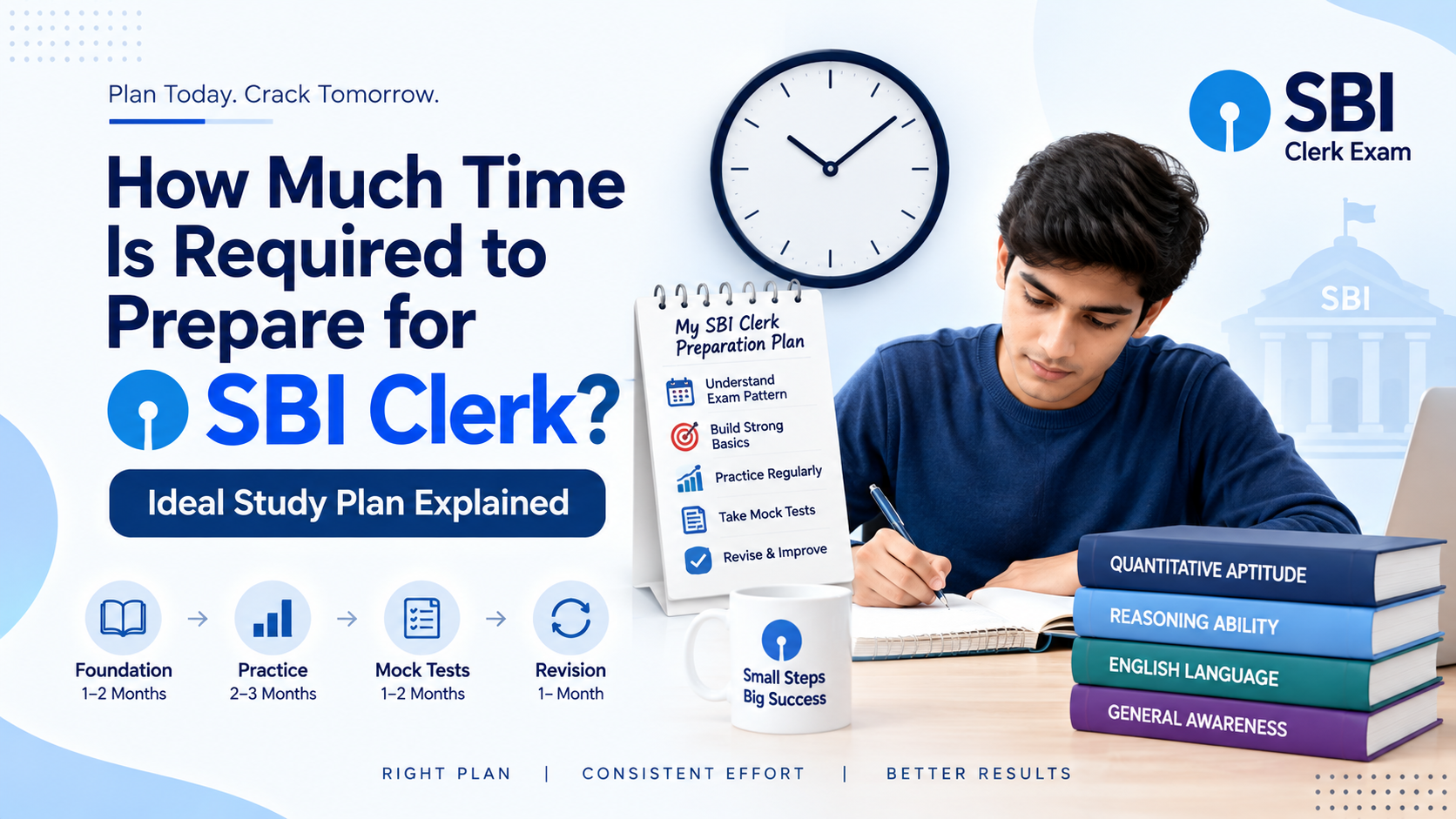
How Much Time Is Required to Prepare for SBI Clerk? Ideal Study Plan Explained
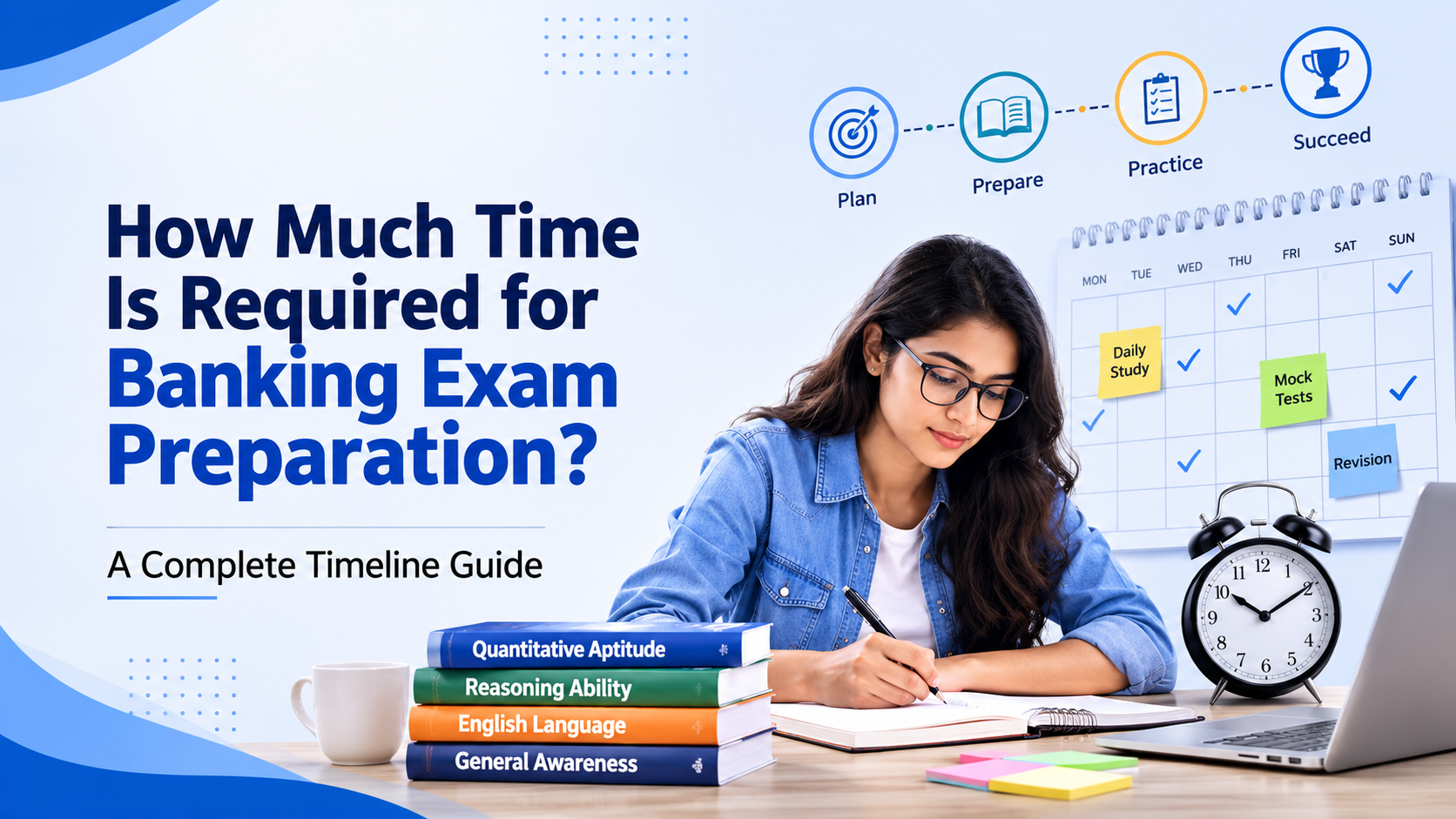
How Much Time Is Required for Banking Exam Preparation? A Complete Timeline Guide