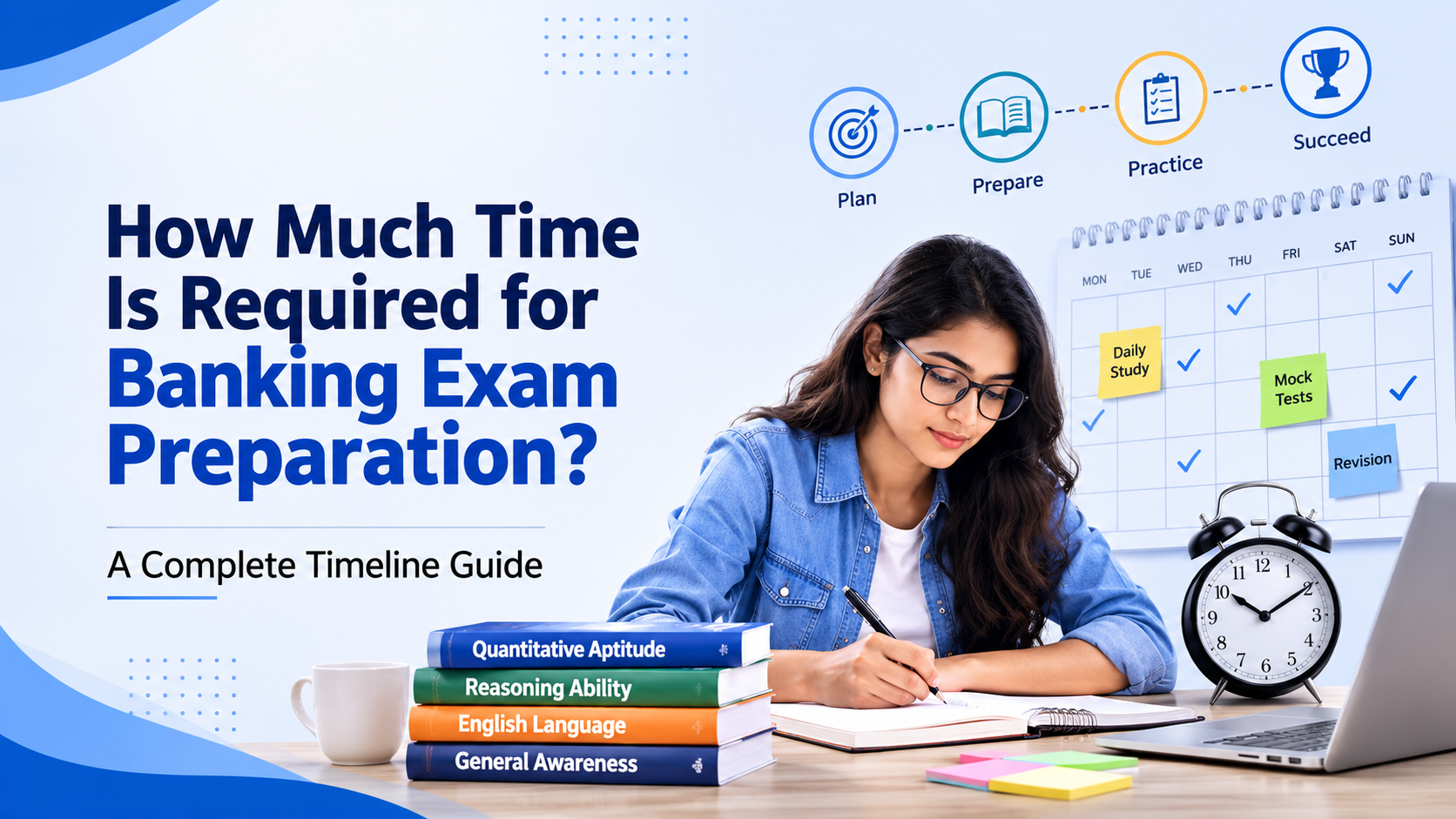
How Much Time Is Required for Banking Exam Preparation? A Complete Timeline Guide

5th August 2026
Banking exam preparation is not just a matter of studying a lot. You have to find a smart way to study and allocate the time you give it to complete the syllabus, practice regularly, and revise well. Many aspirants get stuck at that point. They either start preparing too late, or they don’t have a plan for months.
Fortunately, there are online bank exam preparation courses available that allow you to work at your own speed and benefit from expert advice, mock tests, and study plans. This guide will take you through a realistic preparation schedule, indicate the number of hours you should be studying daily, and provide you with some practical advice to help you prepare with confidence.
How much time is required for banking preparation?
The answer depends on three things –
- where you’re starting from
- how many hours you can put in daily
- and which exam you’re aiming for.
But if I had to give you a straight answer – aspirants who study consistently for 4 to 6 hours a day have a good chance of cracking the exam.
The closer you are to the exam, the more focused study hours you will need each day. Use this table as a reference:
| Time Left | Recommended Study Hours |
| 6 months | 2-3 hours/day |
| 4 months | 3-4 hours/day |
| 3 months | 4-5 hours/day |
| 2 months | 5-6 hours/day |
| 1 month | 6-8 hours/day (with breaks) |
What affects your preparation time?
- Where you currently stand in Quant, Reasoning and English
- How many hours you can realistically study each day
- Whether you are doing this full-time or managing work/college alongside it
- How consistent you are with mock tests and revision
- Which exam you’re targeting – IBPS PO, SBI PO, IBPS Clerk (they’re not all the same)
One thing that will help regardless of your timeline is sticking to a proper online banking preparation routine.
Banking exam preparation timeline (month-by-month)
If you split your preparation into monthly goals… it will make studying much more manageable. So instead of studying aimlessly, you know exactly what to prioritize at every stage of your online bank job preparation.
Follow this timeline –
| Month | Primary Goal | Key Tasks |
| Month 1 | Build your foundation | Understand the exam pattern, complete basic concepts in Quant, Reasoning, and English, and start current affairs. |
| Month 2 | Strengthen concepts | Finish the remaining syllabus, practice topic-wise questions, and revise weekly. |
| Month 3 | Increase practice | Solve sectional tests, improve speed, and identify weak areas. |
| Month 4 | Mock test phase | Attempt full-length mocks every week and analyze every mistake. |
| Month 5 | Revision & PYQs | Solve previous years’ papers, revise formulas, and improve accuracy. |
| Final Month | Final preparation | Focus on revision, current affairs, mock tests, and exam strategy. Avoid learning new topics. |
If you’re preparing over several months, do not try to cover all your syllabus at once because that would not work. Give each month a clear purpose so you can build concepts first and leave enough time for revision.
Tips to make the most of your banking exam preparation timeline
Set realistic monthly and weekly goals
Divide preparation into smaller objectives rather than just on the final examination. Set the monthly topics that you want to complete, and then break it down into weekly objectives. This will make it easier to keep track of your progress & also will help you stay motivated.
Stick to your daily study schedule
Whether you’re studying for two hours, or six, you should try and study at the same time every day, because a consistent routine is far more effective than the long hours you put in only when you feel like it.
Don’t skip revision
Set aside time every week to go back over formulas, shortcuts, vocab, all the important concepts that you’ve covered because if you skip that, you’re just going to forget it all, and that defeats the whole point of your online bank exam preparation.
Increase mock tests as the exam gets closer
Start with sectional tests once you are comfortable with the basics, and as your exam approaches, you should gradually shift to full-length mock tests, but more importantly, spend the time analyzing your mistakes (so that you know exactly what it is you need to improve).

Adjust your plan when needed
It is completely okay to get behind from time to time. Do not try to catch up by studying a lot. You should revise your study plan and move forward – because a flexible timeline that you are able to stick to, has always been better than a perfect plan you eventually give up on, therefore, don’t be so hard on yourself.
Final words
Banking exam preparation is not something so daunting. With reasonable and realistic time, hard work, and a correct approach, you can complete the syllabus without overdoing it. All you have to do is concentrate, monitor progress and never put your practice to the side. But if you need a plan for your online bank job preparation, the right guidance and a proper study plan can help you out.
Speaking of guidance… if Maths has been your weak spot, Aashish Arora’s classes are what you need. His way of breaking down tricky concepts and shortcuts makes even the toughest topics feel manageable.
FAQs
How many hours should I study daily for banking exam preparation?
Most aspirants do well with 4 to 6 focused hours a day. If you have more time before the exam then even 2 – 3 hours daily can be enough with consistent effort.
Can I crack a banking exam in 3 months?
Yes, it is possible – if you already have a basic understanding of the subjects and follow a disciplined study plan with regular mock tests and revision.
When should I start taking mock tests?
Start with sectional tests after building your basics. Once you’ve covered most of the syllabus, begin taking full-length mock tests regularly.
Is online bank job preparation effective?
Yes. A good online preparation course gives you structured lessons, mock tests, doubt support and of course the flexibility to study at your own pace.
Recommended for you
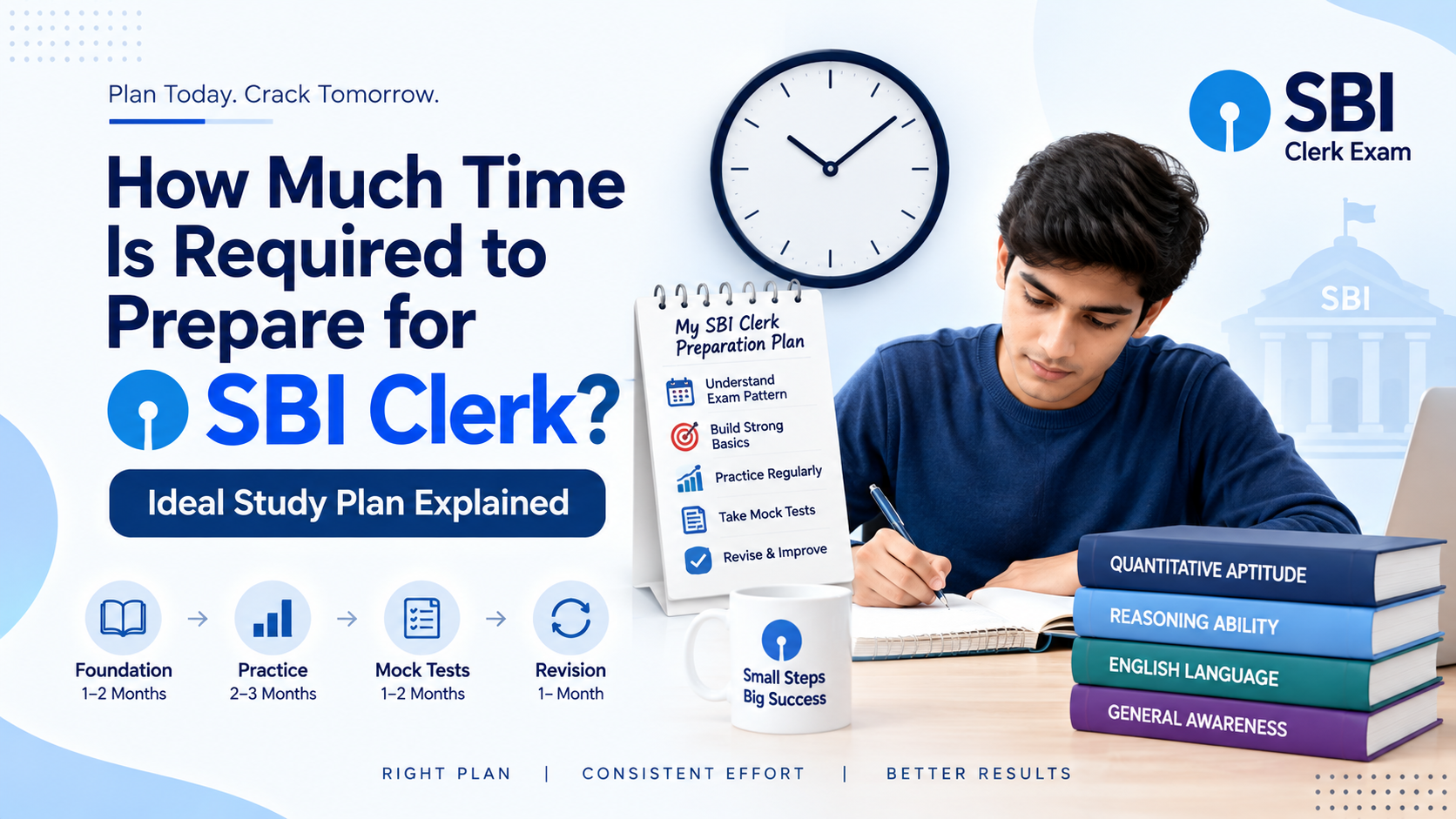
How Much Time Is Required to Prepare for SBI Clerk? Ideal Study Plan Explained
Canara Bank Recruitment 2026: Notification, Vacancy & Exam Date