RBI Grade B Preparation Strategy For Quantitative Aptitude

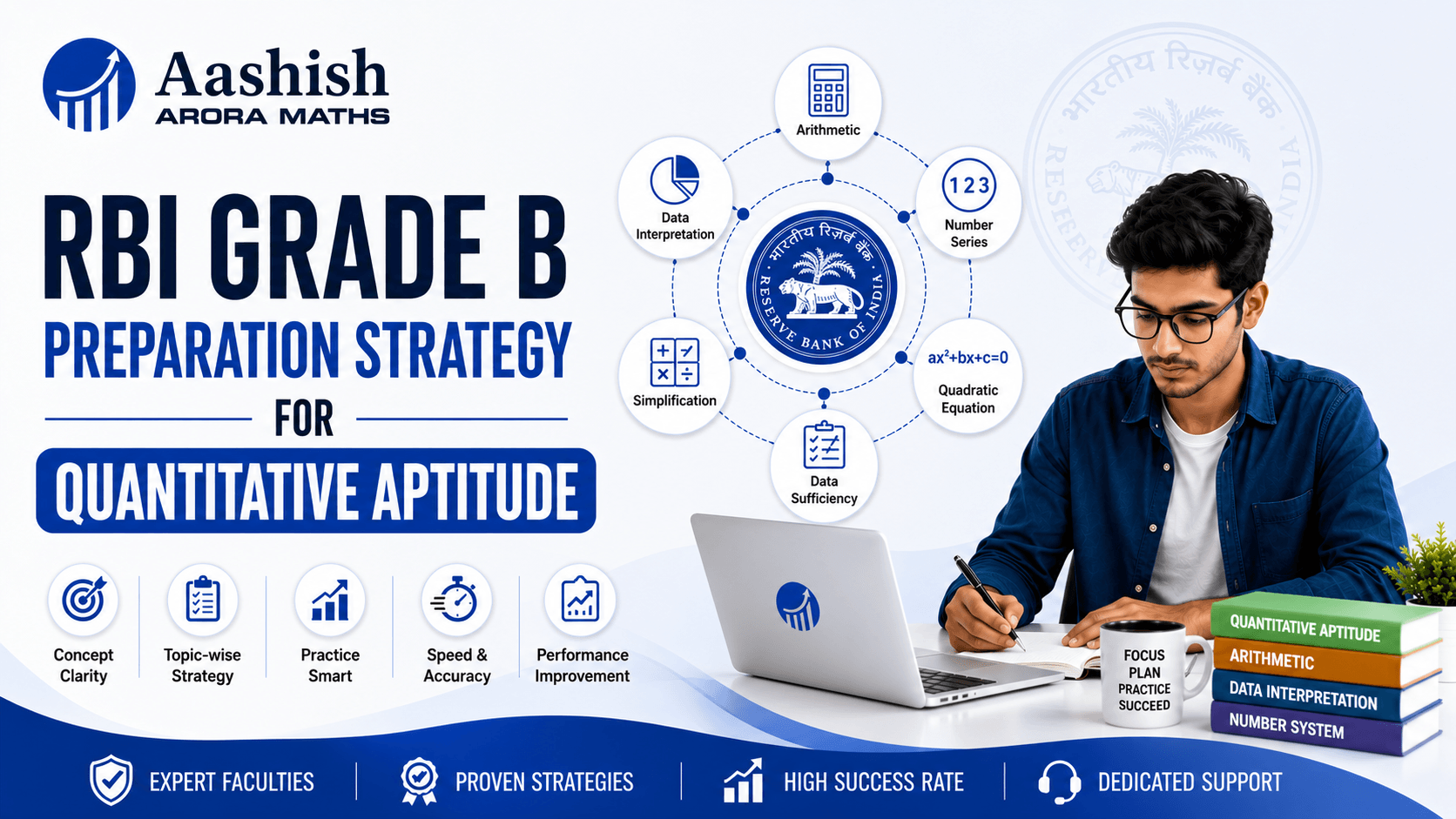
Preparing for the RBI Grade B exam is a journey that requires steady effort, patience, and a smart strategy. Across all the subjects, Quantitative Aptitude frequently emerges as the most formidable section for a multitude of candidates. A segment of individuals hails from non-numeric fields, while others confront difficulties with their pace and precision. Nonetheless, the reality is that Quantitative Aptitude for the RBI Grade B exam doesn’t depend on solving exceptionally complex mathematical puzzles. Thus, partnering with Aashish Arora Maths will get you the best RBI Grade B preparation strategy for better results.
Understand The Nature of RBI Grade B Quant
Before starting preparation, it’s crucial to understand the actual requirements of the examination. The Quantitative Aptitude portion of the RBI Grade B Phase 1 exam typically covers subjects like:
- Arithmetic
- Data Interpretation
- Simplification and Approximation
- Number Series
- Quadratic Equations
- Percentage
- Profit and Loss
- Ratio and Proportion
- Time and Work
- Speed, Time and Distance
- Simple and Compound Interest
- Probability and Permutation
- Mensuration
Build Strong Basics First
Begin with the arithmetic chapters as they establish the foundation for the majority of questions. Subjects like percentages, averages, ratios, and profit/loss are intrinsically linked. If your fundamentals are weak, advanced problems will feel problematic.
Instead of memorising formulas blindly, aim to understand their underlying principles.
For example, understanding the practical application of percentages will solve your problem of simple interest, data interpretation, and profit calculations.
Watch the Full Bank Exams 2026 Strategy
Focus More On Arithmetic & Data Interpretation
In recent times, arithmetic and data interpretation have held weightage in banking exams, including the RBI Grade B. Many aspirants dedicate enormous time to challenging algebra or geometry problems that rarely appear in significant quantities.
A good approach for RBI Grade B preparation is to prioritise:
- Percentage
- Ratio & Proportion
- Averages
- Mixture & Allegation
- Profit & Loss
- Time & Work
- Speed, Time and Distance
- Data Interpretation Sets
Improve Calculation & Speed Daily
Quantitative Aptitude for Banking Exams is not only about understanding concepts but also about solving questions quickly and accurately. Many aspirants know the correct method to solve a problem, yet they struggle to answer within the limited time available during the exam.
To improve your performance in Quantitative Aptitude for Banking Exams, make daily calculation practice a habit. Learn multiplication tables up to 30, squares up to 50, cubes of important numbers, fraction-to-percentage conversions, and commonly used percentage equivalents. Strong calculation skills can significantly increase your speed, reduce solving time, and help you attempt more questions with greater accuracy during the exam.
Solve Topic-Wise Questions Regularly
Upon finishing a chapter, solve the sectional exercises immediately. Do not wait until the syllabus is completed.
A good strategy is to:
- Learn the concept
- Solve easy questions
- Move to moderate level questions
- Practice previous year questions
- Attempt timed quizzes
Mock Tests Are Extremely Important
Regardless of the theoretical material you cover, genuine progress materialises through mock tests. In the beginning, aspirants may feel discouraged due to low scores. This is entirely typical. Mock tests are not designed to evaluate your intellect; they serve as instruments for refining your approach.
While undertaking mock tests:
- Focus on question selection
- Avoid getting stuck on one problem
- Learn time management
- Improve accuracy
Don’t Fear Quantitative Aptitude
A substantial number of RBI Grade B aspirants develop anxiety towards Quantitative Aptitude by comparing themselves to others. Some individuals possess innate computational speed, while others require time to build proficiency.
Your competition is not with top performers showcased online. Your objective should be steady personal advancement. While attempting mocks, remember:
- RBI Grade B Quant is manageable
- Concept clarity beats shortcuts
- Regular practice matters more than talent
- Smart preparation is more important than studying endlessly
How to Prepare Quantitative Aptitude for RBI Grade B
Preparing for Quantitative Aptitude for RBI Grade B requires a combination of conceptual clarity, regular practice, and effective time management. Since the Quant section tests your numerical ability, problem-solving skills, and calculation speed, it is important to follow a structured preparation strategy. By understanding the syllabus, focusing on important topics, practicing mock tests, and improving calculation speed, candidates can significantly increase their chances of scoring well in the RBI Grade B examination.
Aashish Arora Maths: Assisting Aspirants With RBI Grade B Preparation
Under expert guidance, a structured educational path, and a focus on the student, Aashish Arora Maths helps those aiming for the RBI Grade B exam in developing robust Quantitative Aptitude basics with confidence. Covering everything from basic math and data analysis to methods for enhancing speed and practising with mock exams, each topic is presented in an easy-to-understand and applicable way.
Start your RBI Grade B preparation journey with confidence and turn your Quant weaknesses into strengths with Aashish Arora Maths. Join today and prepare smarter, practice consistently, and move one step closer to your RBI dream.
The Final Word
Strategic handling of Quantitative Aptitude can transform it into a strong scoring area as part of the RBI Grade B preparation. Rather than going for absolute mastery of every complex problem, focus on building a solid foundation, increasing your pace, and engaging in regular practice. Begin with manageable steps, maintain your dedication, and have faith in the system. There will be instances when your performance in practice tests is discouraging, but progress in competitive examinations is seldom a straight line. What counts is your continued effort. Thus, following an RBI Grade B preparation strategy is essential at all costs.
FAQs
Q1) Is Quantitative Aptitude difficult in the RBI Grade B exam?
Ans) Quantitative Aptitude in RBI Grade B is considered manageable if approached with the right preparation strategy. The section focuses more on concept clarity, speed, and accuracy rather than extremely difficult mathematics.
Q2) Which topics are important for RBI Grade B Quantitative Aptitude?
Ans) Important topics include Arithmetic, Data Interpretation, Simplification, Number Series, Percentage, Profit and Loss, Ratio and Proportion, Time and Work, Speed, Time and Distance, Probability, and Mensuration.
Q3) How should beginners start RBI Grade B Quant preparation?
Ans) Beginners should start with arithmetic topics such as percentages, averages, ratios, and profit and loss because these form the foundation for advanced chapters.
Q4) Why is arithmetic important for RBI Grade B preparation?
Ans) Arithmetic carries significant weightage in banking exams and helps aspirants solve a wide variety of practical and calculation-based questions quickly.
Recommended for you

Bank of India Credit Officer Recruitment 2026: Complete Notification, Eligibility & Preparation Guide

Complete SBI PO Exam Preparation Strategy To Crack Exam In First Attempt