How to Prepare for SBI Bank PO | Study Plan, Tips, and Mistakes to Avoid

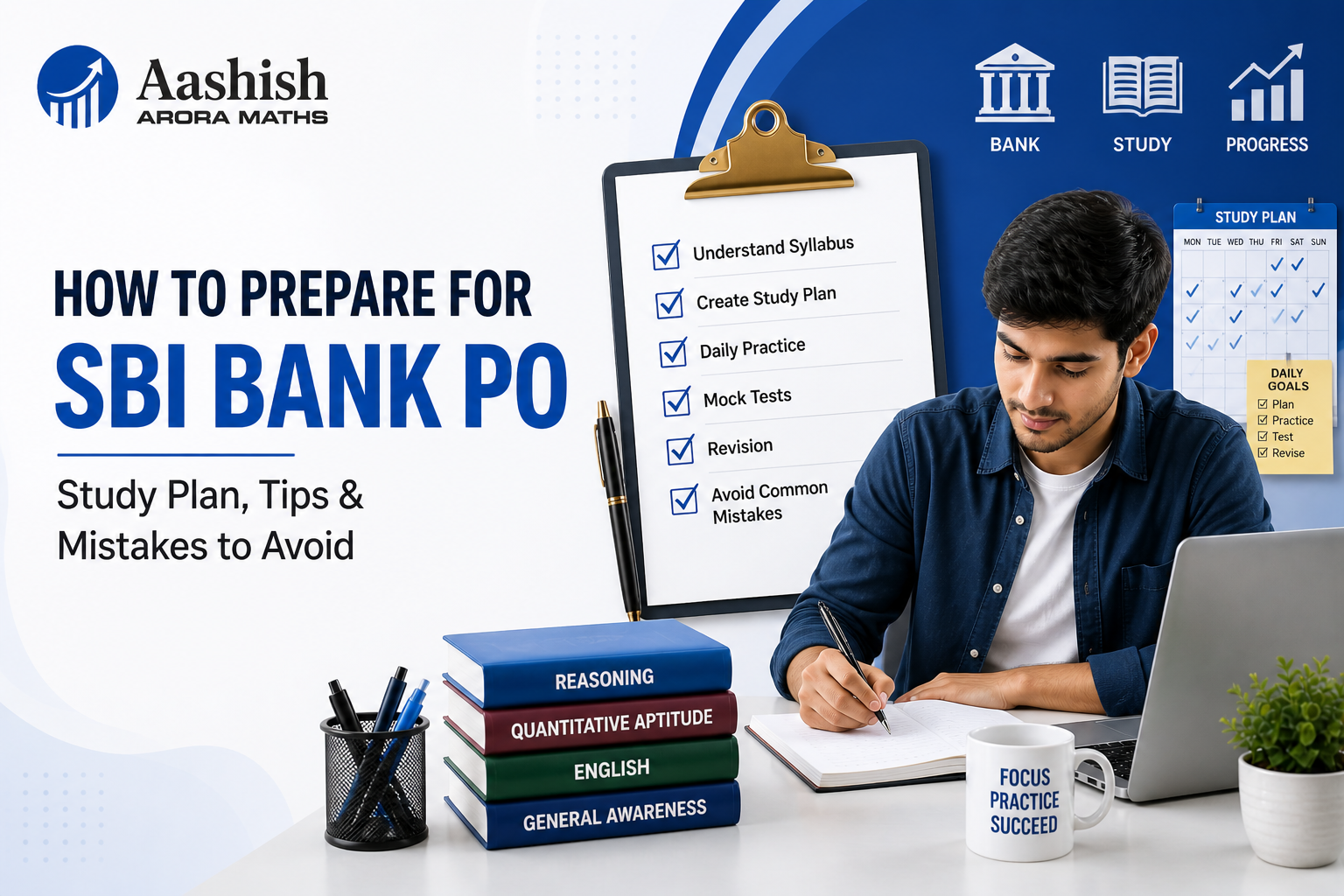
Preparing for the SBI PO exam is about studying in the right way and with a clear plan, hence, you need a strategy that is simple, and also something that you can follow every day, because consistency matters here a lot.
This SBI PO preparation guide will help you understand how to prepare for SBI Bank PO in around 12 weeks so you can cover all the important subjects and not feel lost in between. The idea is not to rush, but to build things step by step.
In the beginning, you should focus on the basics because if your fundamentals are strong, then the rest becomes easier, and then slowly, you move towards mock tests, practice more questions, and also revise what you have already studied, because revision is where most students actually improve.
If you follow a proper plan, and at the same time avoid common mistakes, then your SBI PO exam preparation becomes much more manageable, and less stressful. You start seeing progress, maybe small at first, but it builds up.
And yes, even if you are working or have a busy schedule, you can still prepare for SBI Bank PO, but only if you stay disciplined, and keep going, even on the days when it feels a bit too much.
SBI PO exam pattern & syllabus
If you are starting your SBI PO exam preparation, then understanding the exam pattern is the first thing you should do, because without that, your strategy can go in the wrong direction.
| Stage | Details | Time | Key Points |
| Prelims | 100 questions (English – 30, Quant – 35, Reasoning – 35) | 1 hour | There is a ¼ mark negative marking, so accuracy matters, not just speed. |
| Mains (Objective) | 155 questions for 200 marks (Reasoning & Computer – 45, DI – 35, GA – 40, English – 35) | 3 hours | Each section has separate timing, so you cannot switch between sections freely. |
| Mains (Descriptive) | Letter + Essay writing | 30 minutes | Total 50 marks, and it checks your writing clarity and structure. |
| Interview (Phase III) | Personal interview round | — | Focus is on your personality, confidence, and banking awareness. |
Now when you look closely, you’ll understand that the SBI PO exam is more about managing time and staying calm under pressure than just solving questions. So when you think about how to prepare for SBI Bank PO, make sure you are not skipping any section because every stage is crucial. And yes, many students ignore the syllabus in the beginning but that is where mistakes start happening.
Also, before you fully prepare for SBI Bank PO, just go through the official syllabus once, slowly… it helps you understand what to study, and what not to waste time on.
12-week study plan
When you start your SBI PO exam preparation, it is important to not study randomly, but to follow a plan that moves step by step, therefore, this SBI PO preparation guide breaks the 12 weeks into 3 simple phases.
-
Weeks 1–4 (Foundation Phase)
This phase decides how strong your base will be. You focus on the basics of Quant like arithmetic and algebra, and also simple reasoning topics like puzzles and coding. Along with that, you should read one English passage daily, and start making notes for current affairs because later it gets overwhelming. The goal here is to cover at least one topic from Quant and one from Reasoning every week, slowly but clearly.
-
Weeks 5–8 (Practice Phase)
Now things shift a little. You already know the basics, so now you start practicing more, and more. Solve quizzes, attempt Data Interpretation sets, and also start sectional tests. This is also the time when you begin mini mock tests, under time limits because time pressure changes everything. You will notice weak areas, and yes, it might feel frustrating, but that is exactly what you need to improve.
-
Weeks 9–12 (Revision & Mock Phase)
This phase is all about testing yourself again and again. You should take 2–3 full mock tests for both Prelims and Mains every week. And not just attempt them, but sit and analyze them properly, because that is where real learning happens. Also, for Mains, practice one essay and one letter every week. And keep doing quick daily revisions (formulas, notes, shortcuts) so that things stay fresh in your mind.
In the end, if you are wondering how to prepare for SBI Bank PO, this kind of phased plan makes it much easier, because you are not doing everything at once but building, practicing, and improving step by step.
Topic-wise resources & time allocation
When you start your SBI PO exam preparation, one mistake many students make is using too many resources and then getting confused. So it is better to keep it limited, but the right ones, because that saves time and effort.
For example, you can start with books like Comprehensive Guide to SBI Bank PO, Quantitative Aptitude by R.S. Aggarwal, and A Modern Approach to Verbal & Non-Verbal Reasoning as these books have been used by many students for years and they still work.
For English, Wren & Martin is almost unavoidable, because it helps you understand grammar properly, not just memorize rules. And for General Awareness, you should follow Arihant’s Banking Awareness, along with daily current affairs because that section changes very quickly.
Apart from books, you should also use online platforms like Oliveboard, Testbook, and GKToday, because they help you practice daily, and also test your speed. And yes, if you are serious about how to prepare for SBI Bank PO, then a good test series is not optional, it is necessary.
Now to make things clearer, here’s a quick breakdown:
| Resource | Format | Cost (₹) | Why it helps |
| Comprehensive Guide to SBI PO | Book | 400–500 | Covers both Prelims and Mains, and gives enough practice questions. |
| Quantitative Aptitude (R.S. Aggarwal) | Book | 300–350 | Helps you build strong basics, and practice different types of questions. |
| Analytical Reasoning (M.K. Pandey) | Book | 250–300 | Good for understanding puzzles and logical reasoning step by step. |
| Wren & Martin – English Grammar | Book | 150–200 | Clears grammar concepts, and improves sentence structure slowly. |
| Banking Awareness (Arihant) | Book | 250–300 | Covers banking terms, static GK, and important updates. |
| Oliveboard SBI PO Test Series | Online | 500–1000 | Gives real exam-like mock tests, and helps you track your performance. |
Practice tests & revision strategy
When you are doing your SBI PO exam preparation, mock tests are not just for practice, but they are also for understanding where you actually stand. Because many times, you feel prepared but the test shows something else.
From around Week 7, you should start taking 1–2 full Prelims mock tests every week, and also a couple of Mains mocks, so that you slowly get used to the real exam pattern. But just giving mocks is not enough, and this is where many students get stuck, because they don’t analyze them properly.
After every mock, you should sit and check what went wrong, and what went right. See the questions you missed, and also the ones you got wrong, because sometimes you knew the answer but still made mistakes. It happens, but it should not keep happening.
So, you need to identify the reason – was it because you didn’t know the concept, or because you were running out of time, or maybe you got confused in between. Therefore, keeping an error log helps a lot, where you write formulas, vocabulary, tricks and then you revise them again, and again.
Also, you should solve previous-year papers, because patterns have been repeating, and it gives you a better idea of what to expect. And for Mains, do not ignore writing practice. You should write at least one essay and one letter every week, so that your writing becomes clear, and structured.
So if you are thinking about how to prepare for SBI Bank PO, then remember, revision is not something you do at the end, but it has been part of your daily process.
Time management & sectional tips
Now comes the part that looks simple, but it is not – time management because you may know everything but if you cannot manage time, then it affects your score.
-
Tip 1
You should divide your study time properly so that every subject gets attention, for example, you can dedicate 30–35% of your time to Quant, 25% to Reasoning, and 20% to English. And the rest can go to current affairs and revision. It does not have to be exact but it should make sense for you. Also, always practice with a timer because solving without time feels easy, but in the exam, things change and suddenly time feels less.
-
Tip 2
One simple thing that has helped many toppers is starting with the strongest section, because it builds confidence, and you are able to secure marks early. But then, you should move to the tougher parts, like puzzles or Data Interpretation, when your mind is still active.
-
Tip 3
In Quant, you can use approximation, so that you save time, and in General Awareness, sometimes you can make smart guesses but only when you are somewhat sure.
-
Tip 4
And when you give mocks, try to sit in a quiet place, and follow proper timing, so that it feels like a real exam. It may feel unnecessary at first, but it has been helpful in building focus, and also stamina.
So when you finally prepare for SBI Bank PO, this is where everything connects like what you studied, how fast you solve, and how well you handle pressure, in that moment.
Common pitfalls to avoid
- Cramming without basics. Rote memorization fails on tricky questions; ensure conceptual clarity.
- Skipping regular revision. Failing to revisit material leads to forgotten formulas and concepts.
- Ignoring mock analysis. Taking tests without reviewing mistakes wastes effort.
- Time mismanagement. Getting stuck on hard questions or spending too long on one section can cost many marks.
- Neglecting current affairs. Even one GK question can be crucial; don’t leave current affairs to the last minute.
- Overconfidence. Assuming any section is easy and neglecting practice can backfire.
Aashish Arora Maths: Your SBI PO Preparation Guide
At Aashish Arora Maths, we know that succeeding on the SBI PO exam relies less on intense study and more on strategic, consistent effort with proper mentorship. We concentrate on making Quantitative Aptitude understandable, reinforcing logic abilities, and boosting accuracy when time is limited, ensuring you never feel overwhelmed. We help aspirants with:
- Prioritising studies with an effective approach.
- Significant attention is given to establishing core principles.
- A progressive transition toward practice exercises, mock tests, and review.
- Explaining Math topics in an easy-to-understand manner.
- A focused effort on strengthening analytical talent.
- Guidance from experts with constant review.
So, are you eager to make your SBI PO aspiration a success? Join Aashish Arora Maths now and start your journey with a validated framework, expert coaching, and the guidance necessary for success.
Conclusion
So, in the end, your SBI PO exam preparation is not about doing everything at once, but it is about doing the right things, again and again, along with discipline and patience because consistency is what really makes the difference, not just motivation.
If you are still wondering how to prepare for SBI Bank PO, then this 12-week plan gives you a clear direction, and something that you can actually follow, step by step. It may feel slow in the beginning, but over time, you will see that things start improving.
Most toppers have been saying the same thing that “stay consistent, and analyze your mock tests properly”, because that is where real learning happens. And honestly, that advice works, if you follow it.
So, if you stick to this SBI PO preparation guide, and use the right resources, then you can cover the syllabus in a structured way, and also feel more confident as the exam gets closer.
Just stay focused, keep practicing, and don’t stop in between because eventually, all the effort adds up. Good luck!
FAQs
Q1. How should I start preparing for SBI PO?
Ans). Initially, understand the exam structure and syllabus, and thereafter concentrate on mastering fundamentals in Quantitative Aptitude, Logical Reasoning, and English Language.
Q2. How important are mock tests for SBI PO preparation?
Ans). Mock tests are important since they help in evaluating your progress, boosting rapidity, and fostering test assurance.
Q3. How many hours should I study daily for SBI PO?
Ans). Typically 4-6 daily hours, which relies upon your timetable, where regularity matters more than extended study durations. So, creating a schedule and being regular are important.
Q4. Does Aashish Arora Maths cover the whole syllabus?
Ans). No, Aashish Arora Maths only focuses on Quantitative Aptitude, i.e., solving problems and providing guidance on mathematics.
Recommended for you
How Much Time Is Required to Prepare for SBI Clerk? Ideal Study Plan Explained

How Much Time Is Required for Banking Exam Preparation? A Complete Timeline Guide