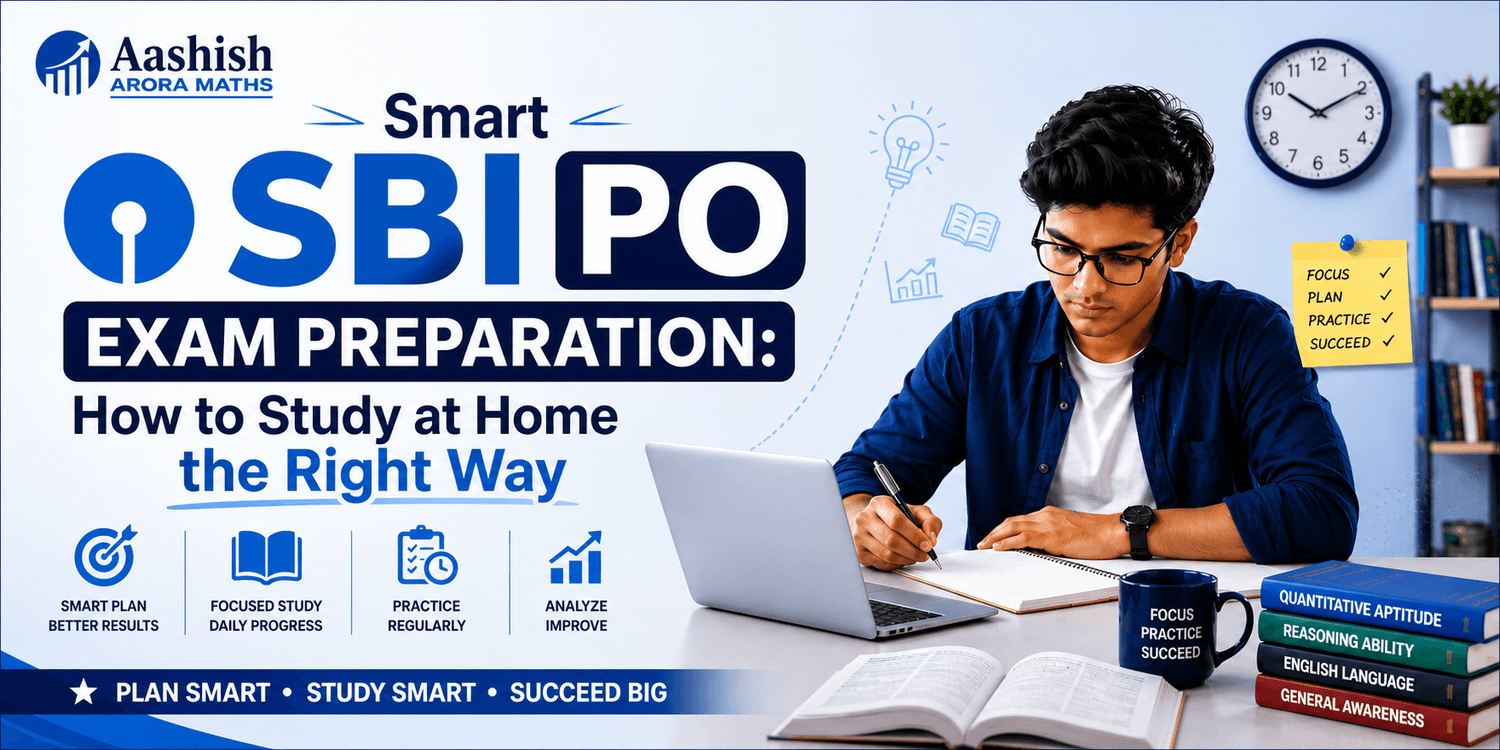
Smart SBI PO Exam Preparation: How to Study at Home the Right Way

The SBI PO exam is one of the most popular banking exams in India, and every year, thousands of aspirants aim for it with one dream. And the dream is to get a secure banking career in SBI. The exam is conducted for the Probationary Officer (PO) role, which comes with a good salary, growth opportunities, and job stability.
Now here’s the interesting part. You don’t necessarily need coaching to crack it. With the right SBI PO exam preparation, you can prepare effectively right from home.
The thing that makes the difference is not how many hours you sit with books. But how smart your study plan is. A focused routine, clear basics, and consistent practice will always outperform long, unplanned study sessions. That is precisely what this SBI Bank PO preparation guide will cover so that you stay structured instead of feeling lost in too many topics.
A Clear Look at the SBI PO Exam Structure
Now, before you start preparing, you need to understand what you are preparing for. The exam basically has three stages: Prelims, Mains, and Interview.
Prelims is the first filter. It checks your speed and basic understanding of Quantitative Aptitude, Reasoning Ability, and English Language.
Mains is more detailed. It tests deeper concepts, including Data Analysis, Banking Awareness, and Descriptive Writing.
Finally, the Interview stage checks your personality, communication skills, and overall confidence.
Understanding this structure is important because it tells you exactly what to focus on at each stage instead of studying everything randomly.
SBI PO Exam Preparation Strategy (Basics, Practice & Mock Tests)
Start with the basics (Always)
Before you think about speed or mock scores, you need clarity. Real clarity. Because in SBI PO exam preparation, weak basics are what slow you down the most.
So, start simple. Quant begins with percentages, ratios, simplification, and number series. Nothing fancy. Just a clear understanding. Reasoning starts with puzzles, seating arrangements, syllogism. English? Focus on grammar rules, basic comprehension, and vocabulary.
It might feel slow at first. That’s fine.
Because once your basics are solid, everything else starts making sense faster. Questions feel familiar. Patterns start clicking. And suddenly, you’re not guessing… You are solving.
Topics to focus on:
- Quant: percentages, ratios, simplification
- Reasoning: puzzles, seating arrangement
- English: grammar, comprehension, vocabulary
Importance of daily practice
Reading concepts feels productive. But practice is where real improvement happens.
You can understand a topic perfectly and still struggle in the exam if you haven’t practiced enough. That’s why daily question-solving is non-negotiable. It will be difficult at first, so start small. Maybe 20–30 questions per section, then increase gradually. Don’t rush into high-level questions immediately. Build your comfort first.
And here’s the part most people skip: review your mistakes.
Ask yourself: Why did you get it wrong? Was it a concept gap? A calculation error? Or just a lack of time?
These small observations make a huge difference over time. Because improvement doesn’t come from solving more questions. It comes from understanding your mistakes better.
Mock tests and analysis
Well, at some point, you need to step out of practice mode and actually feel what the exam is like. The pressure. The time crunch. The constant decision-making. That is precisely what mock tests do. They not only test your knowledge, but they also test how you perform under real exam conditions.
The first few tests might not go well. Scores might feel low. Timing might feel tight.
But that’s okay. Don’t panic.
Mock tests are not meant to show how good you are. They are meant to show where you need to improve. And once you start seeing them that way, your entire approach starts shifting in the right direction.
And here’s where it gets interesting. Mocks slowly train your brain to think faster and smarter. You start recognizing patterns. You begin to spot easier questions more quickly. You get better at skipping what’s not worth your time.
And here is where it gets interesting. Mocks slowly train your brain to think faster and smarter. You start recognizing patterns.
You begin to:
- Spot easier questions more quickly
- Recognize patterns without overthinking
- Skip time-consuming questions more confidently
- Manage time better across sections
Slowly, it stops being about questions and starts becoming about strategy. And that change is what truly sets you apart.
Current Affairs, Revision & Final Preparation at Home
How to handle current affairs
Focus on banking, economy, government schemes, and important national news. Read daily for 20–30 minutes.
Weekly revision strategy
Revise formulas, grammar rules, and reasoning tricks once every week to keep everything fresh.
Why revision is non-negotiable
Without revision, even strong topics get forgotten. Regular revision ensures better retention and exam performance.
Staying consistent till the end
Preparation is not about motivation every day. It’s about showing up daily, even on low-energy days.
Why Aashish Arora Maths Is Ideal for SBI PO Exam Preparation
Choosing the right teacher for the SBI PO exam can honestly change your entire preparation, especially if Maths feels like your weak area. And that’s exactly where Aashish Arora Maths stands out. The difference becomes clear when you look at the numbers:
Lakhs of students trained
9+ Years of Experience
1000+ Recorded Sessions
80,000+ Active Students
So, if your SBI PO preparation has been holding you back, now is the time to fix it. Start learning with Aashish Arora Maths today.
FAQs
Q1. Can I follow an SBI Bank PO preparation guide at home without coaching?
Ans) Absolutely. You can surely follow an SBI Bank PO preparation guide from home. With the right strategy, study plan, and regular practice, self-preparation can be just as effective as coaching.
Q2. How many hours should I study daily for the SBI PO exam preparation?
Ans) You don’t need crazy long hours. Around 4–6 focused hours daily is enough if you’re consistent. What matters more is how well you use that time, not how long you sit.
Q3. When should I start giving mock tests for SBI PO?
Ans) Commence once your basics are somewhat clear. You don’t have to wait till everything is perfect. Begin early, go slow, and improve with each test.
Recommended for you
How Much Time Is Required to Prepare for SBI Clerk? Ideal Study Plan Explained
How Much Time Is Required for Banking Exam Preparation? A Complete Timeline Guide