RBI Bank Exam Preparation: Complete Strategy to Crack RBI Grade B

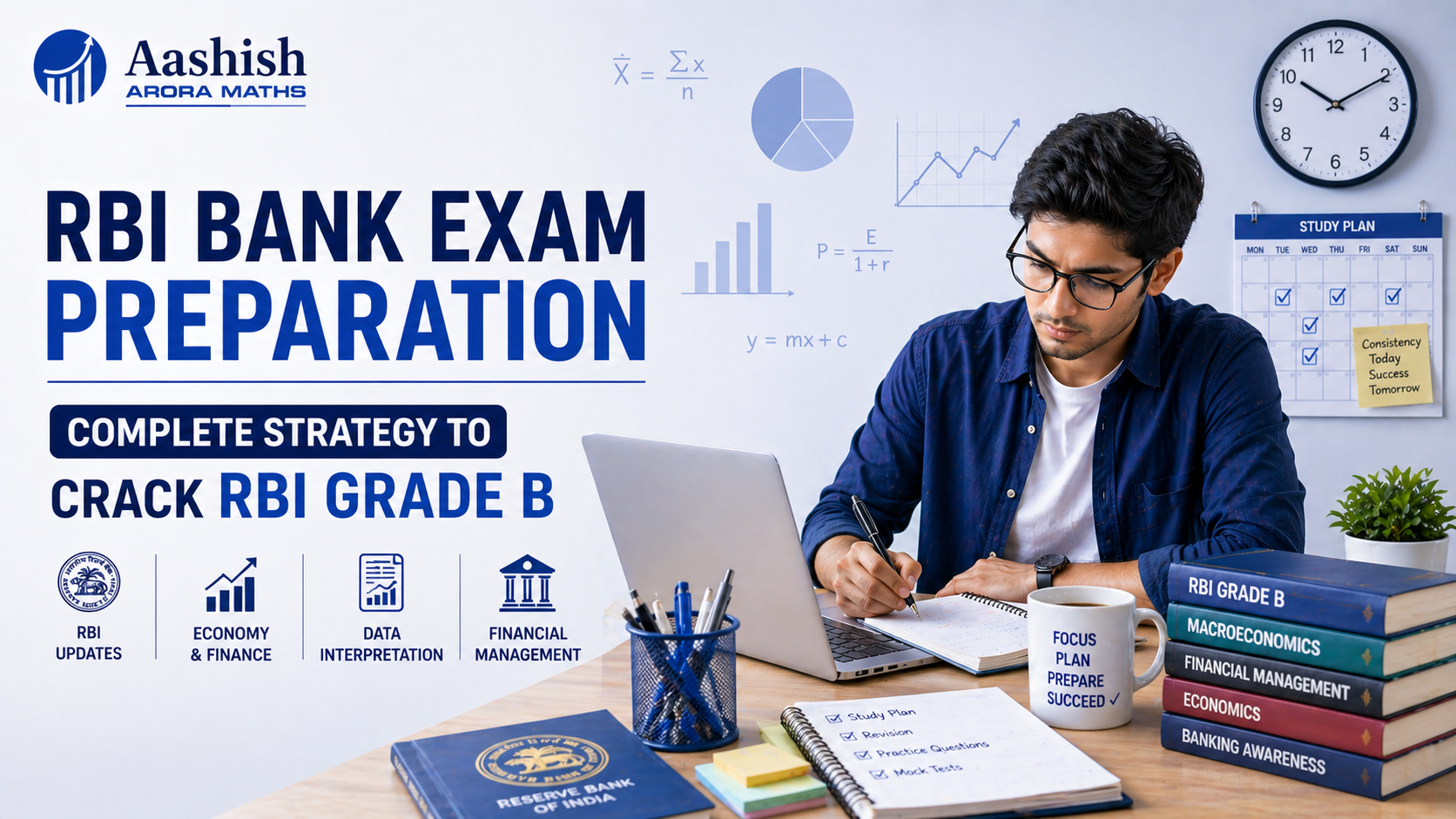
Many candidates begin their RBI Grade B journey in a disjointed manner: hopping between topics, materials, and methods without a defined path.
The issue isn’t the amount of work put in. It’s the absence of a structured plan.
Success in RBI bank exam preparation hinges on recognizing that each phase of the examination calls for a distinct strategy. Prelims assesses quickness, Mains probes thoroughness, and the interview evaluates sharpness of thinking. Applying the same method to all three is a common pitfall.
Once you view the exam as sequential stages rather than a single massive syllabus, your RBI bank preparation naturally becomes more concentrated and manageable.
This guide is precisely designed for that: to help you initiate your RBI bank preparation the right way, so you don’t have to keep restarting.
RBI Bank Preparation: Understanding the RBI Grade B Exam Structure
The majority of hopefuls dive into preparation without proper foresight, which is usually where problems begin.
The RBI Grade B exam is not a single-level hurdle. It is a process with multiple tiers, and each tier requires something specific from you. This is why a uniform preparation style seldom succeeds in RBI bank exam preparation.
The initial phase is Prelims. It is objective and a filtering mechanism. Some of the sections that you will find in it include Reasoning, Quantitative Aptitude, English, and General Awareness. Speed and precision are the main goals here, rather than comprehensive understanding. You have to meet the cutoff, and that is all it requires. However, do not underestimate it. Numerous serious candidates are weeded out at this stage by just making fun of it.
Then there is Mains, where a substantive challenge is found. Speed is replaced by the focus on understanding. You are going to address Economic and Social Issues (ESI), Finance and Management (FM), and a descriptive English part. At this point, the expectation is for you to consider, dissect, and articulate, rather than just selecting options. This stage measures your grasp of principles and how lucidly you can express your insights.
Finally, there is the interview. By this stage, it transcends mere knowledge. It concerns the coherence of your thoughts, your general awareness, and your self-assurance. You must be familiar with what you have learned and capable of discussing it logically.
This is precisely why your RBI bank preparation must be stratified. What performed well on Prelims will not perform well on Mains, and vice versa, and what you do on Mains will not completely prepare you to be interviewed. The wiser idea is to know what each stage requires at the very beginning and to plan accordingly to those needs.
How to Start Your RBI Bank Exam Preparation the Right Way
It might be easy to be bewildered when you first start preparing for RBI Grade B. The information is too abundant, there are too many strategies, and everybody appears to be doing it differently. The fact is, though, that excellent RBI bank exam preparation does not begin with the more. It begins with making a few essential things right at the outset.
Start with Clarity, Not Just Motivation
High motivation is the starting point for the majority of aspirants. They download materials, set lengthy study goals, and just plunge into studying. However, this motivation dies away easily without understanding.
Take a step back and understand what you are preparing for. Read through the pattern, syllabus, and past year questions of the exam. This provides you with guidance. As soon as what is important and what is not is known, your preparation will automatically be more specialized.
This is where RBI bank preparation really begins. Not with action, but with knowledge.
Set Goals You Can Actually Follow
It is easy to create an ambitious timetable. It’s far more difficult to follow it consistently.
Instead of scheduling 10-hour studying days at the beginning, establish a routine that suits your ability at the moment. It only takes a few hours a day (5-6) with consistent practice. Set your preparation in weekly goals as opposed to unrealistic daily targets.
The idea is simple: consistency over intensity.
Choose Fewer Resources, But Better Ones
Too many study materials are one of the greatest errors that most people commit during the RBI Bank exam preparation phase.
Better preparation does not imply more books. Actually, it normally results in confusion and partial coverage. Select one or two credible sources on each topic and use them. Do not keep changing, but revise several times.
Depth always beats variety in the long run.
Avoid the “Everyone Is Doing This” Trap
You will find numerous tips on the internet: new tactics, various lists of books, and new ways of doing things. You are tempted to continuously change your plan according to the other people.
However, the truth is the following: the more you switch your strategy, the slower you are.
Stick to a plan that works for you. Give it time. Improvement in RBI bank preparation comes from consistency, rather than trying out all the new techniques you encounter.
Focus on Building a Strong Base
You may not need to think about mocks or advanced topics, but you need to be sure that you understand the basics.
It could be Quant, Reasoning, or concepts in ESI and Finance: it depends on what you base it on. When you have your basics in place, then everything is easy. Otherwise, you will continue to struggle regardless of practicing.
So take your time in the beginning. It pays off later.
The Right Start Makes Everything Easier
The early phase of your preparation sets the tone for everything that follows.
When you begin with clarity, realistic goals, and the correct resources, your path will be easier. You will not be confused or overwhelmed every few weeks. Rather, you will be heading in one direction.
That’s what the right RBI bank exam preparation looks like: not rushed, not chaotic, but clear and consistent from day one.
Final 30–60 Days Strategy
This phase is simply about refining and not diversifying.
Increase your mock test frequency, but don’t compromise on analysis.
Turn your attention to revision. You should go back to your notes, formulas, and other key concepts rather than taking on new topics.
Work on accuracy and speed. Even small improvements here can significantly boost your score.
In the case of Mains, descriptive writing should be a daily habit. It makes your thoughts organized and enhances articulation.
This is also the phase where mindset matters the most. Stay calm, trust your preparation, and avoid last-minute panic.
Preparing for RBI Grade B is not about doing everything. It is basically about doing the right things consistently. Your RBI bank preparation should be structured, realistic, and adaptable. There will be days when things don’t go as planned; that’s normal. What matters is getting back on track. Stay disciplined, keep refining your strategy, and focus on steady progress. Because in the end, it’s not the smartest or the fastest who succeed; it’s the ones who stay consistent long enough.
Ashish Arora: Thousands of Aspirants Guided Toward Better Preparation
When it comes to RBI Grade B preparation, choosing the right guidance can make a real difference. Ashish Arora has built his approach around one core idea: making preparation structured, practical, and result-oriented rather than overwhelming.
What sets his guidance apart is not just teaching, but the outcomes and consistency behind it:
- Years of focused experience in guiding competitive exam aspirants
- A proven track record of helping students build clarity in Quant and exam strategy
- Structured learning approach designed specifically for banking exams
- Thousands of aspirants reached through guided preparation and learning support
- A strong emphasis on concept clarity, speed-building, and exam-oriented practice
Unlike scattered preparation methods, the focus here is on simplifying the journey – so aspirants can stay consistent and confident throughout their RBI bank exam preparation.
Why wait, when you can start preparing the right way today? Start your preparation with Ashish Arora Maths.
FAQs
1. How long does RBI bank exam preparation take?
It depends upon where you begin, although, on average, most serious aspirants spend 6-9 months of preparation. With good basics in place, it may not take as long. It is not the length but the consistency.
2. Is coaching necessary for RBI Grade B preparation?
Not necessarily. A number of candidates are able to pass the exam through self-study. What is more important is to possess the right resources, a clear plan, and practice.
3. How many hours should I study daily?
It has no definite limit; however, 5-6 concentrated hours per day is an excellent place to begin. The more important thing is how you utilize that time.
4. When should I start giving mock tests?
You may begin when you have cleared your basics to some extent. Start with 1-2 mocks/week and increase the frequency towards the exam. Always aim at analysis, not just efforts.
Recommended for you
How Much Time Is Required to Prepare for SBI Clerk? Ideal Study Plan Explained

How Much Time Is Required for Banking Exam Preparation? A Complete Timeline Guide